How do you know whether an AI system is actually any good?
It is a deceptively hard question. A model can sound fluent and confident while being wrong, off-tone, or subtly unhelpful. This post lays out the four main ways teams evaluate AI systems, what each one costs, and how they fit together into a working evaluation loop.
Four ways to evaluate
1. Code-based evaluation
The cheapest option. You write code that runs a deterministic pass/fail check on the model’s output — does the answer contain the expected value, return valid JSON, fall within a numeric range? This works well for questions with a single verifiable answer.
Its strength is also its limit: code can confirm correctness on well-defined tasks, but it can’t judge whether an answer was tactful, well-reasoned, or appropriate in tone.
2. Human evaluation
Here a human in the loop — often a domain expert — rates the model’s outputs as good or bad against a set of criteria. In practice this lives in a spreadsheet: one column per criterion (for example, product knowledge, tone, factual accuracy), with reviewers scoring each response.
This is the most expensive method, but also the most precise, because it captures the nuance that automated checks miss.
The catch is consistency. If two reviewers disagree about what counts as a “good” answer, your labels are noise. This is where inter-annotator agreement comes in.
Measuring agreement between annotators
Inter-annotator agreement (IAA) quantifies how consistently different humans apply the same labels. The standard coefficients are:
- Cohen’s κ (kappa) — agreement between two annotators.
- Fleiss’ κ — a generalization of kappa to more than two annotators.
- Krippendorff’s α (alpha) — a flexible coefficient that handles multiple annotators, different measurement scales, and missing data.
A common rule of thumb for interpreting these values:
- ≥ 0.8 — strong agreement; the labels are reliable.
- 0.6 – 0.8 — moderate agreement; usable, but treat conclusions with some caution.
- < 0.6 — problematic; the annotation scheme or the reviewers’ shared understanding needs work.
These thresholds are heuristics, not laws. As Artstein and Poesio note in their survey of agreement measures, a single coefficient can never fully capture the complexity of a real annotation task — different aspects of the labeling will be reliable to different degrees. The number is a starting point for investigation, not a verdict.
3. LLM as a judge
What if you used one language model to grade the outputs of another? “LLM-as-a-judge” does exactly this: a model labels results against your criteria, approximating human judgment at a fraction of the cost and time.
It is powerful, but it has real biases. LLM judges are sensitive to prompt wording and can be unstable on edge cases, where their verdicts wobble in ways a careful human’s wouldn’t.
One solution is human calibration. The idea:
- Build a golden dataset of examples that humans have already labeled.
- Have the LLM judge label the same examples.
- Check the match rate between the LLM’s labels and the human labels.
- Refine the judge — its prompt, criteria, or instructions — until its judgments line up with the human ground truth.
Once an LLM judge is calibrated against trusted human labels, it can scale your evaluation far beyond what manual review alone could cover.
4. User evaluation (real-world signals)
Finally, you put the system in front of real users and collect metrics and feedback from actual usage. This is the ultimate test — it reflects genuine behavior rather than a curated test set — though it arrives latest in the process and is hardest to control. Notably, learning from real human feedback is the same principle behind how modern assistants are aligned in the first place - using reinforcement learning from human feedback (RLHF), where human preferences over model responses directly shaped the model’s behavior. Evaluation and training, in other words, draw on the same well: structured human judgment.
The evaluation loop in practice
Putting it together, here is the workflow I find most useful. The key idea is that it scales gradually:
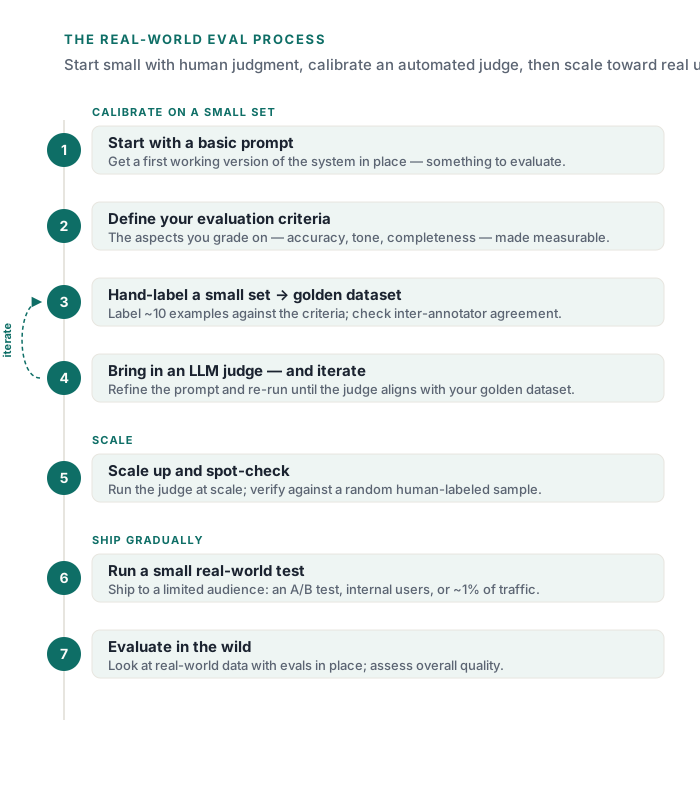
- Start with a basic prompt. Get a first working version of the system in place — something to evaluate.
- Define your evaluation criteria. Decide the aspects you’ll grade the system on — accuracy, tone, completeness, and so on — turning vague dissatisfaction (“the answers feel off”) into concrete, measurable dimensions.
- Hand-label a small set to build a golden dataset. Have your team label at least ~10 examples against those criteria, and check inter-annotator agreement so you can trust the labels. This labeled set becomes your golden dataset — the ground truth everything else is measured against.
- Bring in an LLM judge — and iterate. Run an LLM-as-judge over those same examples and align its labels with your human labels. This is the iterate stage: refine the prompt, re-run, and compare until the judge’s verdicts match your golden dataset. Once they do, you have an automated grader you can actually trust.
- Scale up and spot-check. Run the LLM judge across a large set, then randomly sample a subset for humans to label and confirm the judge still agrees with them at scale. Keep tuning the judge until it can reliably stand in for human labels — at which point you can trust it for scaled analysis and A/B testing.
- Run a small real-world test. Ship to a limited audience: an A/B test, internal users, or maybe 1% of live traffic.
- Evaluate in the wild. Finally, look at real-world data with your evals in place and assess how good the system is overall.
Closing thought
Good evaluation is less about any single clever metric and more about discipline: defining what you mean by quality, measuring it consistently, and being honest about where your measurements are shaky. The tools range from a few lines of pass/fail code to a panel of expert reviewers, but the underlying question never changes — can I trust this, and how do I know?
References
- Bai, Y., Jones, A., Ndousse, K., et al. (2022). Training a Helpful and Harmless Assistant with Reinforcement Learning from Human Feedback. arXiv:2204.05862.
- Artstein, R., & Poesio, M. (2008). Survey Article: Inter-Coder Agreement for Computational Linguistics. Computational Linguistics, 34(4), 555–596.
- Khan, A. (2025). Complete Beginner’s Course on AI Evaluations in 50 Minutes.
- DeepLearning.AI. Evaluating AI Agents.